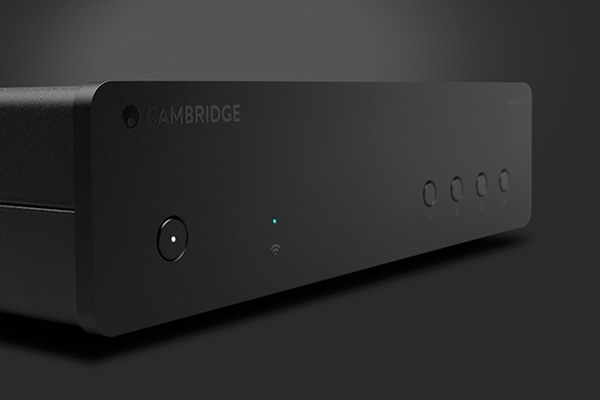
Device Type: Upsampling D/A Convertor
Input: (2) S/PDIF (Coax and TosLink), Async USB
Output: 1 pair RCA
Dimensions: 95mm W x 40mm H x 170mm D (6 2/3" x 3 3/4" x 1 2/3")
Weight: 350g (12 1/4 oz)
Availability: Online and through Authorized Dealers
Price: $349.00
Website:
www.musicalfidelity.com
It’s Easy
As Sam Tellig said in his review of the Musical Fidelity V-DAC II in the January 2012 issue of Stereophile, there really shouldn’t be much uncertainty or confusion surrounding computer audio and high resolution downloads. Oh wait, here’s what Sam actually wrote, “There’s so much uncertainty and confusion surrounding computer audio and high-resolution downloads.” OK, we don't see eye to eye.
Sam also wonders/worries, “Which hi-rez format will win out? How do you store the downloads you’ve bought (Easy. Don’t buy them.) How do you access them? Will digital rights management (DRM) cramp your style, or data storage fees for cloud computing crumple your wallet?”
I can see how, if you take a bunch of computer audio terms and throw them into your word processor and spit them out willy-nilly, you and anyone reading what you wrote might be confused. But connecting a USB DAC to a computer and playing music through it is straightforward for most people who use a computer regularly, which means it’s fairly straightforward for most people without an AARP card (they want me to have one but I keep throwing their letters into the garbage unopened). And the farther away you are from getting that letter, the more comfortable you are around computers, computing, mobile devices, and downloads. It's a matter of evolution.
Of course as with all things audiophile, you can choose to complicate computer audio to your heart’s delight in a quest for better but for those who simply want to play music on their computer through an outboard DAC, life is simple and as time goes by it is also increasingly rewarding for a decreasing investment in time and money.

Pictured with the older-style V-Link (cha cha cha).
The V-DAC II’s most obvious change from the old V-DAC is a formal looking face-lift. Gone is the white feisty font over black and in its place sleek brushed aluminum is adorned with all-business black lettering. Inside, the USB input gained the ability to handle up to 24-bit/96kHz in Asynchronous USB mode where the old version was stuck at adaptive mode 16/48. The V-DAC II shares the same chipset as the upper-scale Musical Fidelity M1 DAC: the Texas Instruments Burr-Brown SRC4392 sample rate converter and the Texas Instruments Burr-Brown DSD1796 D/A chip.
The Musical Fidelity V-DAC II, or MK II which I’ve seen it called but not on the Musical Fidelity website or on the unit itself or in the manual where it remains the V-DAC II, is like its bigger brother, an upsampling DAC. The V-DAC II takes your incoming music file and converts it to 24-bit/192kHz regardless of its original state (unless it’s already 24-bit/192kHz in which case it simply passes through). The V-DAC II inputs include Coax (24/192), Toslink (24/96) and Asynchronous USB (24/96) and outputs through a pair of single-ended RCA jacks. There’s a small toggle switch on the input side to select your input of choice and a 1.3mm DC power socket on the other side to plug in the included wall wart power supply. There are two LEDs one blue one green, the former indicating power (there’s no way to turn the V-DAC II off unless you unplug it) and the latter indicating that you are properly connected to your source when illuminated. And they manage to pack all of this into a package roughly the size of a fat paperback book (or smaller and fatter than your average e-reader).
Of course you have to tell your computer and possibly your media player of choice to play your music through the V-DAC II but the PDF manual available for download from the Musical Fidelity website tells you how to do the computer part (do you think anyone will have a problem deciding where to store that PDF download or how to play it back?) Once you’ve accomplished the physical and virtual connections, you are ready to listen. I did so mainly through my MacBook Pro using iTunes/Pure Music v1.84 using both Toslink and USB (via an AudioQuest Carbon USB cable), connected to the Leben CS-300XS/DeVore Fidelity The Nines.
It’s Fun
Let’s not beat around the bush—I agree with Sam in that the Musical Fidelity V-DAC II is fun to listen to. I played all sorts of music including ripped CDs, CD-quality FLAC downloads and high-rez downloads up to 24-bit/176.4kHz. However, the V-DAC II only saw 24/96 and lower resolutions coming out of my MacBook Pro. The reason for this is twofold; the V-DAC II’s USB and Toslink inputs are limited to 24/96 (as is the MacBook Pro’s Toslink output) and Pure Music takes care of downsampling any higher-rez files prior to passing them along to the V-DAC II. The funny thing that happened on the way to the hi-fi is the V-DAC II then upsampled everything to 24/192.
Now that may sound complicated but try describing the journey a glass of wine makes from point A (in the glass) to point B (digestively) and you’ll quickly realize we manage to do and enjoy all kinds of things even though we may not know exactly what’s going on on the inside. The more important part is the music coming out of the V-DAC II and it sounds mostly unfiltered like a fine homemade wine. I say mostly because the V-DAC II does have a hardish edge and that edge resides mainly around the upper frequencies. Bass also lacks some weight and heft tipping music toward zippy and fast. To stick with the wine analogy, things ultimately sound a tad under-ripe.
Some people point to the power supply as the V-DAC II’s Achilles heel and online retailers like Audio Advisor sell the V-DAC II pre-packaged with an outboard regulated power supply. Musical Fidelity also offers an add-on external power supply (V-PSU II $249). Perhaps this would iron out some of that harshness and thinness I heard but I did not have an opportunity to test this theory. I know, another potential Giant Killer opportunity missed but the recently reviewed Musical Fidelity M1 DAC (the new one) certainly adds some heft and finesse along with its internal regulated power supply.
If there’s one thing some audiophiles love, it’s the idea of great sound on the cheap. It’s as if you’re beating all those people who’ve spent more than you did (or more than you can afford to) at their own game. The problem with this thought process is that’s not the game. Rather the game is we buy hi-fi gear in order to enjoy music and whoever does so with the stuff they own is the real winner. And here’s the kicker—regardless of how much money was spent.
Nothing’s Free
Overall I found the Musical Fidelity V-DAC II eminently listenable and enjoyable which, and here’s the funny part, considering its price makes me smile. That's because I can enjoy a bargain as much as the next guy and the idea that you can buy a device for $349, connect it to your computer on one end and your hi-fi on the other and play music that’ll make your CD player weep with envy is cause for celebration. We are living in a Golden Age of musical enjoyment both in terms of the abundance of music available and the means to play it back and that holds if we’re living on Wall Street, Main Street or On Golden Pond.